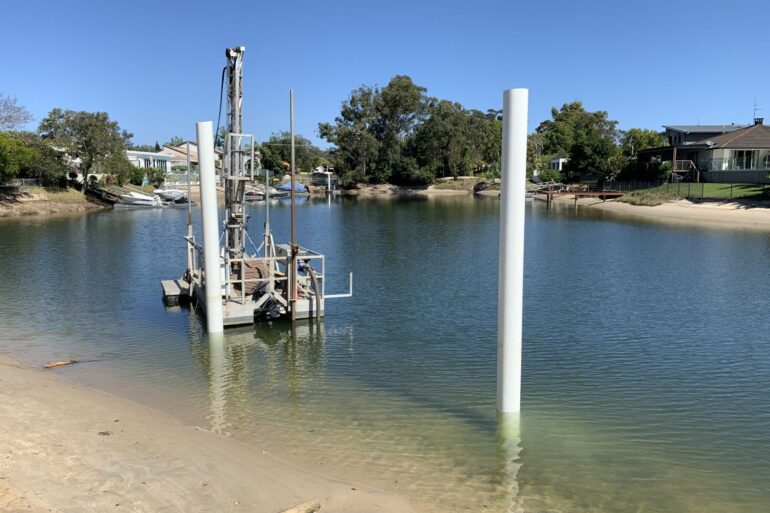
Pontoon piling in Brisbane plays an important role in how floating pontoons perform in bayside marine environments shaped by tides, soft seabed conditions, and regular water movement. In these settings, Brisbane pontoon piling provides the structural foundations that help pontoons remain stable, aligned, and predictable as water levels change.
Along Brisbane’s bayside waterways, tidal marine environments place ongoing demands on waterfront structures. Subtle shifts in the seabed, combined with daily tidal movement, can influence how a pontoon responds over time. Installing piles into the seabed allows loads to be transferred below the surface, helping manage movement while still allowing the pontoon to rise and fall naturally with the tide.
Our pontoon piling services in Brisbane are offered exclusively to waterfront properties in Cleveland and Scarborough, where local access and marine conditions are suited to this type of installation. As with any marine structure, piling is not a standard solution—it is assessed based on site conditions, usage requirements, and long-term performance considerations.
What Pontoon Piling Is and How It Works
Pontoon piling is a type of marine piling used to control the behaviour of a pontoon dock in water. It involves forming piles directly within the seabed to create deep-set foundations that provide a fixed reference point below the surface. Rather than preventing movement altogether, this approach manages how a pontoon responds to tides and day-to-day use.
At Micks Marine Maintenance, pontoon piling is carried out using in-situ piling methods, where piles are formed in place within the seabed. Once installed, pile brackets are fitted around each pile and connected to the pontoon. These brackets guide the structure through vertical tidal movement, allowing it to rise and fall with changing water levels while maintaining lateral restraint.
A piled pontoon typically uses multiple piles, with the number and spacing determined by pontoon size, layout, and site conditions. This configuration influences how loads are transferred into the seabed and how movement is controlled across the structure. The same deep-set foundation principles are used across a range of marine structures that require long-term positional control and load transfer.
Why Pontoon Piling Is Used in Brisbane Marine Environments
Marine environments around Brisbane are shaped by tidal forces, water movement, and varying seabed conditions that influence how floating structures behave over time. In these settings, marine piling is often used to provide controlled support for a piled pontoon, helping to manage movement without restricting the pontoon’s natural rise and fall with the tide.
Brisbane’s coastal and bayside waterways experience regular tidal ranges that can create lateral forces on pontoons, particularly where current flow is present. Even in sheltered areas, changes in water level and seabed composition can affect seabed stability beneath a pontoon. Piling transfers loads below the seabed, reducing reliance on surface-level restraint and contributing to predictable alignment in changing conditions.
The influence of Moreton Bay introduces additional variability, including tidal exchange and ongoing water movement that can affect long-term durability. By accounting for site conditions rather than assuming uniform environments, pontoon piling supports safety and consistent performance across a range of Brisbane waterfront settings.
Common Pontoon Piling Options and When They’re Used
In marine construction, different piling options are used for pontoons depending on soil conditions, loading requirements, and long-term exposure to the marine environment. These piling options are selected based on how effectively they transfer loads into the seabed and how they perform under ongoing water movement.
- Concrete piles: Concrete piles are commonly used where good soil conditions allow for consistent embedment and reliable load transfer. They offer strong structural capacity and are valued for their durability in marine environments.
- Spun concrete piles: Spun concrete piles are manufactured to create a dense, uniform structure and are typically lighter than solid concrete piles. They are suited to specific pontoon applications where controlled loads apply, though their performance under radial loads must be carefully considered during design.
- Steel piles: Steel piles provide high structural capacity and are often used where deeper embedment or slimmer pile profiles are required. In marine settings, corrosion resistance and long-term protection are key considerations due to constant exposure to water and tidal conditions.
While these pile types are used across the marine industry, Micks Marine Maintenance installs pontoon piles using in-situ piling methods, where piles are formed directly within the seabed. This approach allows pile installation to be adapted to site conditions and supports controlled installation for long-term performance in tidal marine environments.
Our Pontoon Piling Installation Process
At Micks Marine Maintenance, pontoon piling is approached as a controlled, methodical process designed to suit the specific conditions of each waterfront site. Every installation begins with an assessment of practical factors such as water depth, marine access, and seabed characteristics to determine how piling can be carried out accurately and safely.
Marine piling works are completed using specialised equipment, including a piling barge, which positions and forms piles in the correct location in the water. This equipment provides the stability and access required to work efficiently in tidal environments while maintaining control throughout the installation process.
Piling installation follows a structured sequence. Piles are positioned precisely before being embedded into the seabed to the required depth using in-situ piling methods. Care is taken to achieve correct embedment depth and maintain installation tolerances as each pile is formed. Once the piles are in place, alignment and connection checks are carried out to ensure structural alignment and compatibility with the pontoon system.
This focus on controlled installation, accurate positioning, and installation quality helps ensure piles perform as intended in marine environments and support long-term structural reliability.
Pontoon Piling for Brisbane Waterfront Homes
Pontoon piling for Brisbane waterfront homes is typically used when private pontoons provide everyday access to the water, rather than for commercial or high-load marine use. In residential settings, piling supports predictable movement and stable positioning, helping private pontoons remain practical and easy to use over time.
For homeowners in Cleveland and Scarborough, piling suitability is closely tied to how the pontoon will be used, including vessel size, frequency of access, and the need for safe movement between land and water. Matching the piling approach to these domestic requirements helps maintain consistent access without over-engineering the structure.
Our pontoon piling is designed for long-term performance and access safety, ensuring the pontoon remains suitable for everyday use in a residential setting.
Learn about our other pontoon services in Brisbane.
Pontoon Piling Brisbane: Book Your Site Assessment
Pontoon piles are not a standard solution and should always be assessed against site-specific conditions before any piling work is considered. Factors such as water depth, access, seabed characteristics, and intended pontoon use all influence whether Brisbane pontoon piling is structurally suitable for a particular location.
At Micks Marine Maintenance, marine piling decisions are based on informed planning rather than assumptions. A site assessment allows local conditions to be reviewed and helps determine how piles would interact with the seabed and the surrounding marine environment over time. This assessment-first approach supports structural suitability, predictable performance, and safe long-term use.
If you are considering pontoon piling in Brisbane, arranging a site assessment is the appropriate next step. It provides clarity on feasibility and ensures that any piling approach is aligned with site conditions and the pontoon’s specific requirements.
Contact us to arrange your site assessment today, or visit our Pontoon & Jetty Piling service page to learn more about piling.